Snowflake ❄️ Summit 2026
Beyond the AI Hype — What Matters Now

Snowflake Summit 2026 wrapped up in San Francisco last week (June 1–4). Unfortunately (after 5 live presences), I was not able to attend live this time but the announcements were substantial. This is not a marketing recap. It is a practical overview of what was announced, what state each feature is actually in, and what you should care about as a data or BI professional.
Note: This blogpost is collected, aggregated and generated by AI
How to read this post: Status legend
Every announcement has a status label. Here is what each means:
GA — Generally Available. Supported in production. You can use it now.
GA soon — Generally Available soon. Confirmed to be GA imminently but not yet production-released.
PuPr — Public Preview. Finished enough to evaluate seriously and plan for. Not yet production-hardened.
PrPr — Private Preview. Invite only. Talk to your account executive if you want in. Subject to change.
DEV — Still in development. Worth knowing about, not worth planning around yet.
Data Engineering and Architecture
Source: Snowflake open framework press release
The biggest theme here is interoperability. Snowflake is leaning hard into Apache Iceberg as the open table format that lets data move across engines without lock-in.
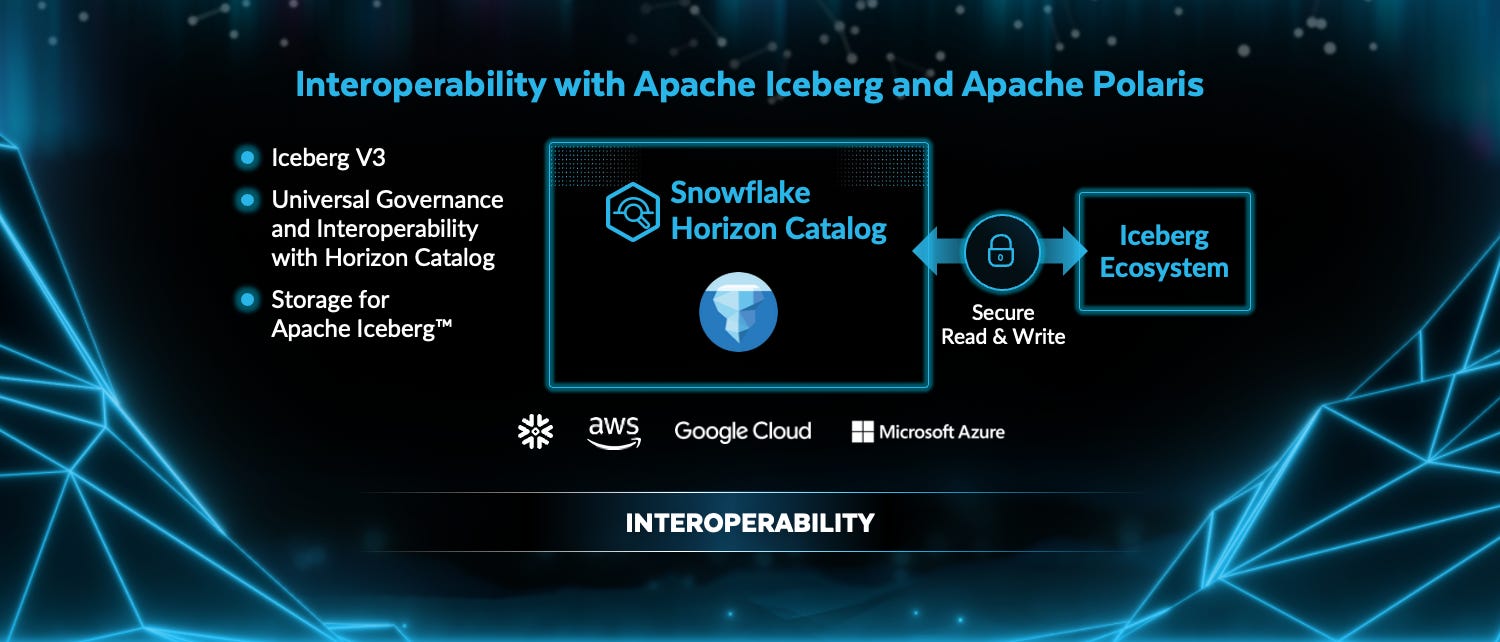
Apache Iceberg v3 Support — GA. Full read/write interoperability across query engines. If you are running multiple tools against the same data, this matters. Product page
Snowflake Storage for Apache Iceberg Tables — GA. Fully managed Apache Iceberg storage inside Snowflake. No external cloud storage configuration required. This removes a real pain point from earlier Apache Iceberg setups. Product page
External Engine Write Support — GA. Bi-directional read/write access via the Horizon Catalog (Apache Polaris). Other engines can now write to your Snowflake data, not just read from it. Horizon Catalog
Iceberg REST Scan Plan API — PrPr. Fine-grained governance across open, compatible engines. Early days, but the direction is clear. Docs
Snowflake Datastream — DEV. A Kafka-compatible managed streaming service, built natively into Snowflake. No separate broker infrastructure to run. Announced at Summit, coming to private preview. Product page
Adaptive Refresh Mode for Dynamic Tables — PuPr. Streamlines pipeline automation by making refresh logic smarter. Release notes
Optimized Refresh for Failover Groups — PuPr. More efficient replication for environments with large object volumes. Relevant if you run multi-region setups. Release notes
Adaptive Compute — GA soon. Auto-scales warehouses based on actual workload patterns. No manual warehouse sizing. Blog post
What this means for you. The Apache Iceberg GA announcements are the ones to act on now. If your organisation is worried about vendor lock-in, or you are running dbt, Spark, or other engines alongside Snowflake ❄️, you now have a stable, governed way to share the same data layer. Snowflake Datastream is worth watching — it is heading toward private preview. If your architecture includes Kafka today, this could simplify your stack considerably once it reaches GA. Adaptive Compute is the quiet win here. Most mid-market teams still tune their warehouses manually. When this lands, that work largely goes away.
CoCo and App Development
Source: CoCo press release
CoCo (formerly Cortex Code) is Snowflake’s AI coding agent. Think of it as a development environment that understands your data and can build workflows, pipelines, and apps with it.
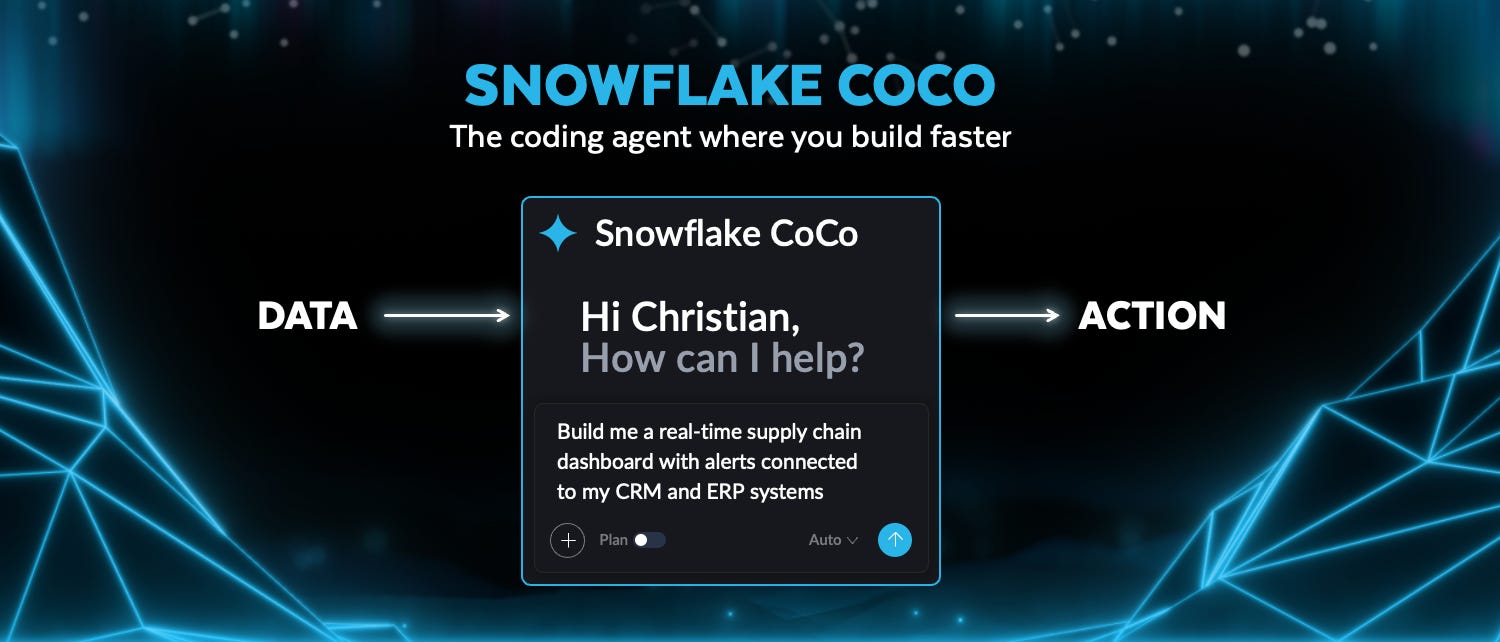
CoCo Native Desktop App — GA. A local application environment for building data workflows, without needing a browser. Coming to GA imminently. Product page
CoCo Ecosystem Extensions — Mixed status. Claude Code plugin, Retool, and Superblocks integrations are GA. VS Code Extension is coming to public preview. Microsoft Excel Extension is heading to private preview. Your existing tools can now (or will soon) talk to CoCo. Product page
Autonomous Task Execution and Cloud Agents — GA soon. CoCo can run workflows automatically in the cloud via Snowsight, with full audit trails. Cloud Agents is confirmed GA soon; Automations capability is heading to public preview. This is not just a chat interface. It takes actions. Product page
Pre-built Skills — GA. Skill Catalog — PuPr. Pre-built Skills for common data engineering workflows are GA. The Skill Catalog for discovering, sharing, and reusing workflows is in public preview. Product page
Snowflake App Runtime — PuPr. Build React and Next.js applications that run inside Snowflake’s security perimeter. Docs
AI, ML, and CoWork
Source: CoWork press release
CoWork is Snowflake’s AI interface for knowledge workers. Previously called Snowflake Intelligence, it has been rebranded and expanded. The goal is to give business users direct, conversational access to enterprise data.
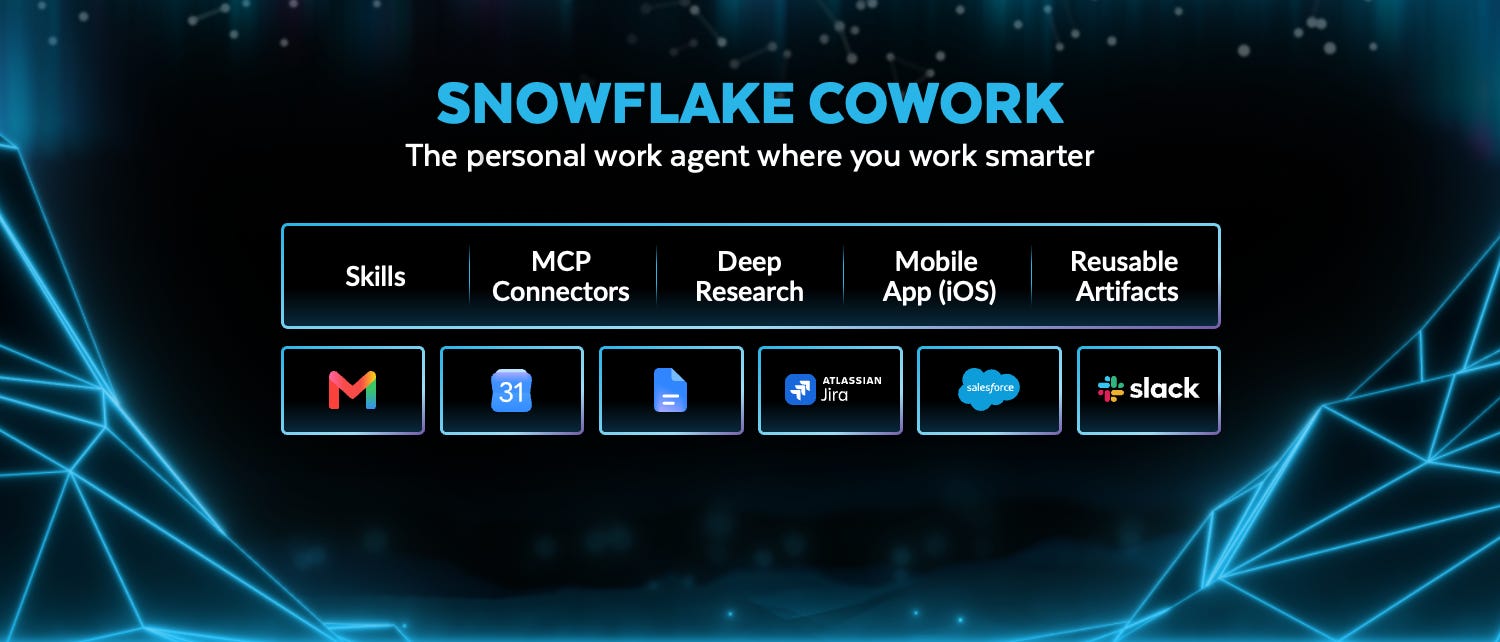
Conversational Artifacts — GA soon. Publishable dashboards that business users can explore through natural language. Not just static reports. Confirmed GA imminently. Product page
Cortex Sense — DEV. Grounds AI agents in your actual enterprise data, business definitions, and operational context. Announced at Summit, heading toward private preview. Product page
Cortex Training — PuPr soon. Train custom AI models on your own proprietary data at scale. Heading to public preview. Product page
Deep Research (CoWork) — GA soon. Multi-step reasoning with deep research capabilities, available inside the CoWork interface. Confirmed GA imminently. Product page
xAI’s Grok models in Cortex AI — GA. xAI’s Grok models are now available in Cortex, alongside Anthropic, OpenAI, Google, Meta, Mistral, and DeepSeek. Cortex AI
Governance and Security
Source: Horizon Catalog press release
Blog: Trusted Data, Trusted AI
This is the area where the most practically useful things happened.
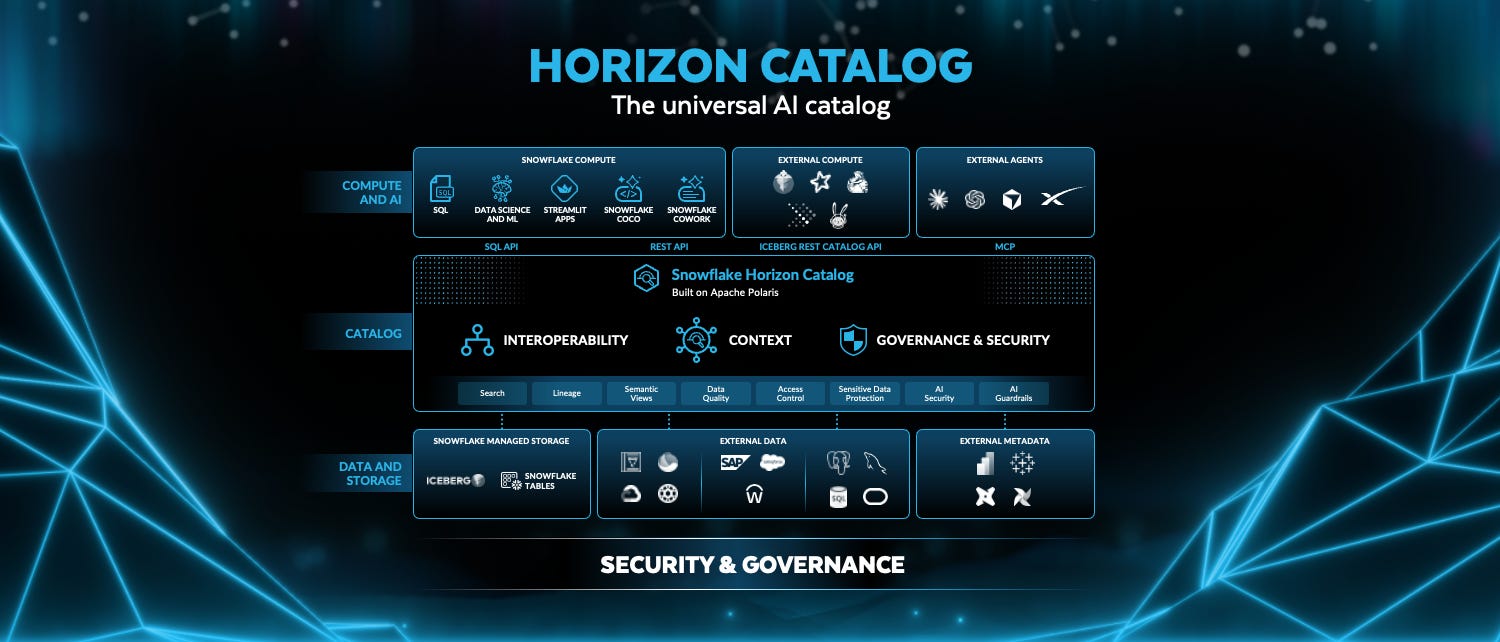
Horizon Context — GA. A semantic layer embedded directly in Horizon Catalog. You define your business logic once, and it is enforced consistently across all agents and tools. No more each team maintaining their own definition of revenue or margin. Product page | Blog
Semantic View Autopilot — GA. Automatically generates business-ready semantic definitions from your existing BI sources. Less manual work to get your Semantic Layer built. Product page
Semantic Studio — PrPr. Define shared business logic without writing SQL. Git versioning is included, which means your semantic definitions are treated like code. Product page
Prompt Injection Detection (Phase 2) — GA. LLM-driven detection of vulnerabilities in AI workflows. As you build more AI-powered pipelines, this is the safety net you need. Blog
Agent Identity — GA. Assigns verified, auditable identities to AI agents operating within the platform. Every agent action is traceable. Already production-ready. Blog
Trust Center Observability — GA. Expanded monitoring and tracking capabilities across your Snowflake environment. Horizon Catalog
What this means for you. Horizon Context is the announcement I would flag most to any team planning to use AI features in Snowflake. The consistent Semantic Layer has always been the missing piece that makes AI-generated analytics unreliable. If an AI agent uses your “revenue” metric but your sales team and finance team define it differently, you get different answers. Horizon Context solves that at the platform level. Agent Identity matters too. The good thing; it is already GA. Once you start running AI agents that take actions on data, you need an audit trail. Not for compliance box-ticking, but because you genuinely need to know what happened when something goes wrong. The fact that this is already in production shows Snowflake is not treating agent governance as an afterthought.
Data Clean Rooms
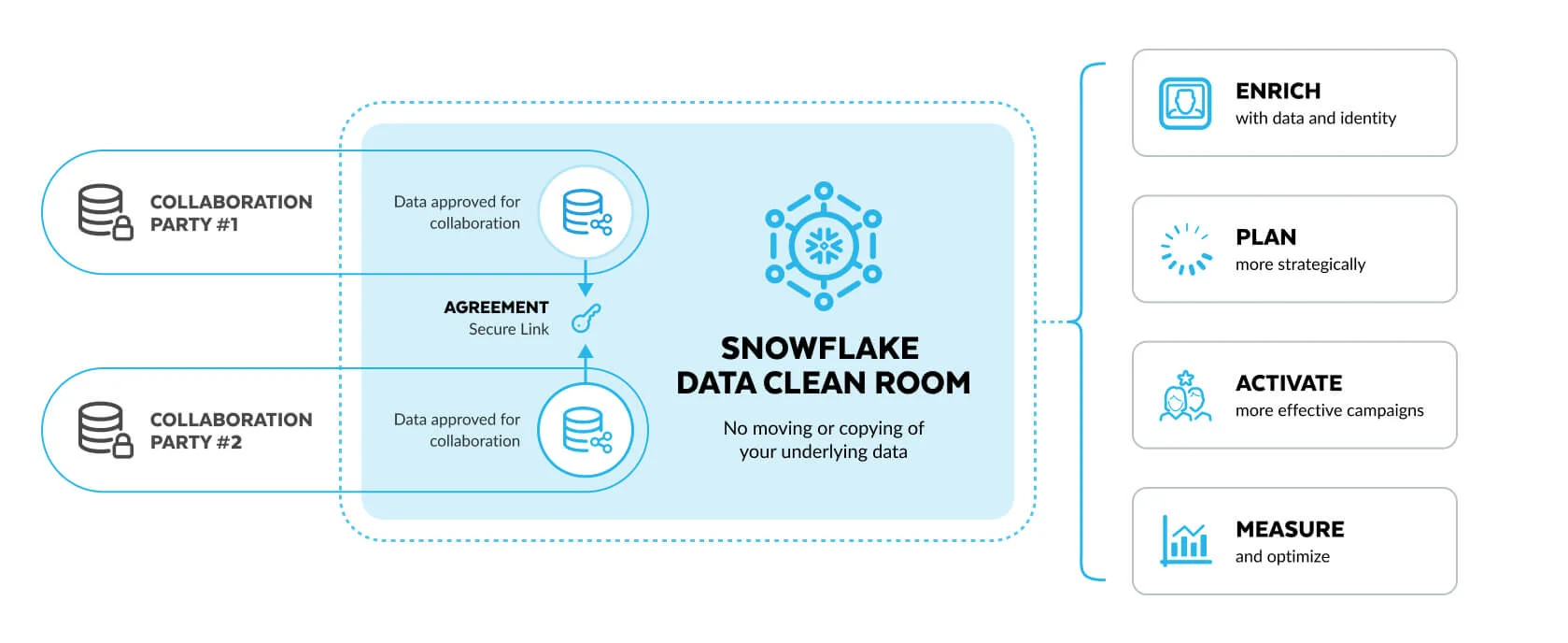
CoCo Skills for Clean Rooms — PuPr. Automated workflows to manage data collaborations and offering templates. Product page
DCR Agent — PuPr. A conversational CoWork interface for running approved clean room analyses, such as audience overlap queries. Product page
Strategic Announcements
These are not product features, but they signal where Snowflake is heading over the next 12 to 18 months.
Snowflake and Anthropic partnership expansion — Announced June 1, 2026. Deeper integration between Snowflake’s platform and Anthropic’s Claude models. Cortex Code is now Snowflake’s fastest-growing product ever with 7,100+ users. Press release
Intent to acquire Natoma — Announced May 27, 2026. Natoma is an enterprise MCP (Model Context Protocol) platform that enables secure connectivity for AI agents across tools and systems. Brings secure agent connectivity natively into the Snowflake ecosystem. Press release
$6 billion AWS collaboration expansion — Announced May 27, 2026. A significant commitment to accelerate enterprise agentic AI adoption on AWS infrastructure. Press release
A practical take
Snowflake Summit was heavy on AI, as expected. But the announcements with the most immediate relevance to mid-market data teams are mostly in the governance and data engineering tracks, not the headline AI demos.
The Iceberg GA announcements give you real options for open architecture. Horizon Context gives you a foundation for AI you can actually trust. Adaptive Compute removes a routine maintenance task. These are not flashy, but they are the ones that reduce friction in your day-to-day work.
The agentic features, CoWork, CoCo’s autonomous execution, and the Natoma acquisition point toward a future where AI agents are running workflows, querying data, and taking actions autonomously. Agent Identity is already GA, which means Snowflake has the governance infrastructure in place for this future today. That is a stronger signal than a preview. It means you can start building with confidence that agent audit trails are a solved problem at the platform level.
For now: if you are not already building your Semantic Layer, start. The tools to do it properly, and to make it the foundation for everything AI-related, are now there.
Snowflake Data Superhero and Chapter Lead for the Dutch Snowflake ❄️ User Group. Consulting Partner at Bravinci. Online also known as; DaAnalytics